Advertisement

Goat Breeding Tips for Livestock Farmers (Urdu)

In order to get maximum meat and milk Beetal, Daira Deen Panah, Nachi, and Teddy Breeds.....

Mango Amazing Facts

The mango is known as the 'king of fruit' throughout the world. The name 'mango' is derived from the Tamil word 'mangkay' or 'man-gay'. When the Portuguese traders settled in Western India they adopted the name as 'manga'.

Pomegranate(Punica granatum) Cultivation and Farming

Pomegranates are fairly drought tolerant and can be grown on either calcareous or acid soils. Climate - Grow best in dry climates with mild winters. Chilling requirement

EU may also ban Monsanto GMO in wake of shocking cancer findings

Russia's consumer protection group, Rospotrebnadzor, said it was halting all imports of GM corn while the country's Institute of Nutrition will be evaluating the results of the study.

Protect Garden Pots during Winter

Many pots, especially ornamental containers that aren’t designed to stand outside in freezing temperatures, need winter protection. Wrap them up in burlap (possibly double layers), and secure tightly at the top and bottom with strong garden string.

Sustainable Agriculture and Fertilizers Practices in Pakistan

Agriculture is the mainstay of Pakistan’s economy. It has a total area of 79.61 million hectare, and the total area used for crop production is only 22 million ha.

Herbs For Winter Windowsill

Growing season is over, do you still find yourself ready to dash out to the garden for some chives, basil or a sprig of thyme...

Claim FREE EBook

Once you subscribe you will get a confirmation email from eagri about joining the mailing list.

Advertisement

Showing posts with label Disease. Show all posts

Friday, January 11, 2013

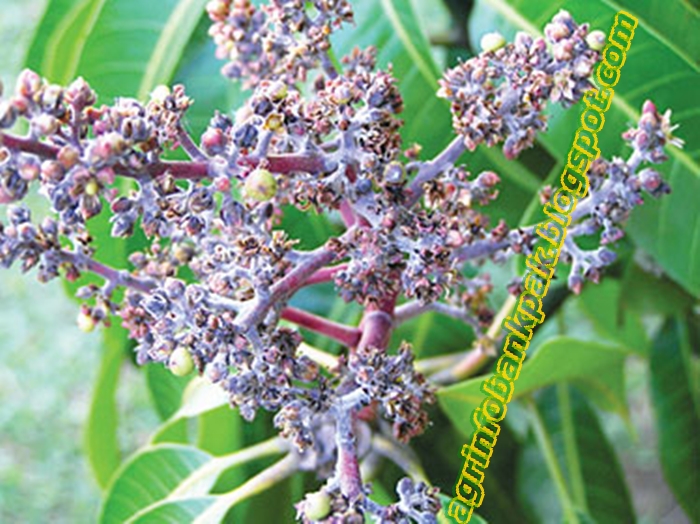
Mango Diseases and Management

Mango

Diseases

Powdery Mildew (Oidium mangiferae)


Powdery mildew is one of the most serious diseases of mango affecting almost all the varieties. The  characteristic symptom of the disease is the white superficial powdery fungal growth on leaves, stalk of  panicles, flowers and young fruits. The affected flowers and fruits drop pre-maturely reducing the crop load considerably or might even prevent the fruit set. Rains or mists accompanied by cooler nights during flowering are congenial for the disease spread.

Control : Alternate spraying of Wettable sulphur 0.2 per cent (2 g Sulfex/litre), Tridemorph O.1 per cent  (1 ml Calixin/litre) and Bavistin @ 0.1 % at 15 days interval are recommended for effective control of  the disease. The first spray is to be given at panicle emergence stage.

Anthracnose (Colletotrichum gloeosporioides) :

It is of widespread occurrence in the field and in storage. The disease causes  serious losses to young shoots, flowers and fruits under favorable climatic  conditions (high humidity, frequent rains and the temperature range of 24-32°C). The disease produces leaf spot, blossom blight, withered tip, twig blight and fruit rot symptoms. Tender shoots and foliage are easily affected which ultimately cause die back of young branches. Older twigs may also be infected through wounds, which in severe cases may be fatal. Black spots develop on panicles. Severe infection destroys the entire inflorescence resulting in failure  of fruit setting. Young infected fruits develop black spots, shrivel and drop off.  Fruits infected at mature stage carry the fungus into storage and cause considerable loss during storage, transit and marketing.

Control : The diseased twigs should be pruned and burnt along with fallen leaves. Spraying twice with  Carbendazirn (Bavistin 0.1%) at 15 days interval during flowering controls blossom infection. Spraying  of copper fungicides (0.3%) is recommended for the control of foliar infection. Postharvest disease of mango caused by anthracnose could be controlled by dip treatment of fruits in Carbendazim (0.1%) in hot water at 52 C for 15 minutes.

Die Back (Botryodiplodia (Lasiodiplodia) theobromae) :

Die back is one of the serious diseases of mango. The disease on the tree may be noticed at any time of the year but it is most conspicuous during October-November. The disease is characterized by  drying of twigs and branches followed by complete defoliation, which gives the tree an appearance of  scorching by fire. Initially it is evident by discoloration and darkening of the bark. The dark area  advances and extends outward along the veins of leaves. The affected leaf turns brown and its  margins roll upwards. At this stage, the twig or branch dies, shrivels and leaf falls. This may be  accompanied by exudation of yellowish brown gum.

Control : Pruning of the diseased twigs 2-3 inches below the affected portion and spraying Copper  Oxychloride (0.3%) on infected trees controls the disease. The cut ends of the pruned twigs are pasted  with Copper Oxychloride (0.3%).

Phoma Blight (Phoma glomerata) :

The symptoms of the disease are observed only on old leaves. Initially, the lesions are angular, minute,  irregular, yellow to light brown, scattered over leaf lamina. As the lesions enlarge, their colour changes  from brown to cinnamon and they become almost irregular. In case of severe infection such spots  coalesce forming patches resulting in complete withering and defoliation of infected leaves.

Control : The disease is controlled by spraying Benomyl (0.2%) just after the appearance of the  disease followed by 0.3% Miltox (Copper Oxychloride + Zineb) at 20 day interval.

Bacterial Canker (Xanthomonas campestrispv. mangiferaeindicae) :

Canker is a serious disease in India. The disease causes fruit drop (10-70%), yield loss (10-85%) and  storage rot (5-100%). Many commercial cultivars of mango including Langra, Dashehari, Arnrapali,  Mallika and Totapuri are susceptible to this disease. The disease is found on leaves, petioles, twigs,  branches and fruits. The disease first appears as minute water soaked irregular lesions on any part of  leaf or leaf lamina. Several lesions coalesce to form irregular necrotic cankerous patches. In severe  infections the leaves turn yellow and drop off. Cankerous lesions also appear on petioles, twigs and  young fruits. The water soaked lesions also develop on fruits which later turn dark brown to black. They  often burst open, releasing highly contagious gummy ooze containing bacterial cells.

Control :Three sprays of Streptocycline (0.01%) or Agrimycin-100 (0.01%) after first visual symptom  at 10 day intervals and monthly sprays of Carbendazim (Bavistin 0.1%) or Copper Oxychloride (0.3%)  are effective in controlling the disease.

Red Rust (Cepbaleuros virescens) :

The disease attack causes reduction in photosynthetic activity and defoliation of leaves thereby  reducing the vitality of the host plant. The disease is evident by the rusty red spots mainly on leaves and  sometimes on petioles and bark of young twigs. . The spots are greenish grey in colour and velvety in  texture. Later, they turn reddish brown. The circular and slightly elevated spots sometimes coalesce to  form larger and irregular spots. The affected portion of stem cracks. In case of severe infection, the  bark becomes thick, twigs get enlarged but remain stunted and the foliage finally dries up.

Control : Two to three sprays of Copper Oxychloride (0.3%) is effective in controlling the disease.

Sooty Mould (Meliola mangiferae) :

The disease is common in the orchards where mealy bug, scale insects and hoppers are not controlled  efficiently. The disease in the field is recognized by the presence of a black sooty mould on the leaf  surface. In severe cases, the trees turn completely black due to the presence of mould over the entire  surface of twigs and leaves. The severity of infection depends on the honey dew secretion of the above  insects. Honey dews secretions from insects stick to the leaf surface and provide necessary medium  for fungal growth. Although the fungus causes no direct damage, the photosynthetic activity of the leaf  is adversely affected.

Control :Pruning of affected branches and their prompt destruction followed by spraying of Wettasulf  (0.2% )+ Metacid (0.1 %)+ gum acacia (0.3%) helps to control the disease.

Diplodia Stem-end Rot(Lasiodiplodia theobromae) :

The fungus enters through mechanically injured areas on the stem or  skin. The fungus grows from the pedicel into a circular black lesion  around the pedicel.

Control : Careful handling to minimize mechanical injuries. Postharvest dip of fruits in Carbendazirn (0.1%) in hot water at 52 ± 1°C for 15 minutes controls the disease in storage and transit.


Sunday, December 16, 2012

AAB monitoring device, cultural practices and chemicals for management of mango tree mortality


By Dr. R. D. Khuhro, Dr. S. M. Nizamani, M. M. Jiskani and M. A. Talpur
Faculty of Crop Protection, Sindh Agriculture University Tandojam

Mango, Mangifera indica is one of the important fruits of Pakistan which is exported to many countries such as Dubai, Saudi Arabia, UK, Germany, France, Holland, Switzerland, Italy, Singapore and Malaysia. It is known as “King of Fruits” and is consumed both by poor and rich people in various forms. Mango is grown is tropical and sub-tropical countries of the world. In Pakistan, it is grown on large acreages of Sindh and Punjab provinces. There are numerous varieties of mango, each differing in fruit characters such as taste, flavour, colour, tinge, shape and size which determine the quality of the fruits and market value at home and abroad (Jiskani, 2002).
Mango tree plant suffers from various insect pests and diseases. Among insects, mango hoppers, fruit flies, thrips, scales, stem borers, shoot borers and mites are reported (Talpur and Khuhro, 2003; Soomro, 1988). Similarly, various diseases caused by fungi such as Fusarium, Aspergillus, Botryodiplodia, Penicillium and Colletotrichum are also reported on mango (Hafiz, 1986; Ramos et al., 1991 and 1997; Wagan et al., 200; Al-Adawi, 2005). During 2002-3 in Pakistan and Sindh, the mango was grown over an area of 102.8 and 46.5 thousand hectares and the production was 1034.6 and 335.9 thousand tones per hectare, respectively (Agha, 2004). Currently, mango trees are dying suddenly at the rate of 2-20%, depending upon severity of disease and management by the owners of mango orchards.

Causes

Asian ambrosia beetle (ABB) is considered as the primary cause of the mango mortality followed by different species of fungi. Basically, this is a management problem. The owners of mango gardens give their gardens on contract and forget about care of the garden whereas, contractors don’t apply proper fertilizer, cultural and plant protection practices as per requirement of the gardens. In this way, the problem of mortality in mango is multiplying. If this, scenario remain constant, we shall end up with mango cultivation and loose export exchange in next few years. The mango growers are warned to expend at least 10% of their income on management operations for the sustainability of mango fruit in their own interest and country at large; therefore, garden owners must not depend on contractors.


Characteristics of AAB

The Asian ambrosia beetle (ABB) has stout dark reddish-brown body and is reported as pest on broad host range including woody ornamentals, fruit and nut trees (Atkinson et al., 1988; Kovach, 1986). Schedl (1962) reported 124 hosts of ABB. The beetle has been collected and identified from various samples taken from dead or partially dead mango trees, Shisham, Gold Mohar, Gular, Neem, Eucalyptus, Siris Albizzia lebbek, rubber plant and Casia fistula from various ecological zones of Sindh. Only females have wings and disperse with small movement from infested and dead mango trees, wood logs/pieces and by its own short movements. These beetles are so tiny that initially attacked trees, don’t show symptoms. In case of severe infestation, the small pin head sized holes appear with the inside and outside movement of beetle on bark. The beetles excavate galleries in the branches, trunks, roots and twigs. The beetles introduce fungi complex in the mango tree and lay their eggs in clusters. In some mango trees no holes in bark appear but black spots on the basal parts of trunks are present. After cutting those barks, the light yellow paste with bad odour watery secretion flows. The beetles are also present in infested black basal part of the trunk. The gum like secretion/drops commonly known as gummosis oozes out from holes of trunks/branches of mango trees infested with beetle. The “C” shaped, legless, white grubs of beetle are found feeding on inner darkened portion of barks. From the infested trunk of the mango tree, the frass of the beetle is pushed out of galleries, in a typical tooth-pick fashion.
Management:

A. Asian ambrosia beetle monitoring device

· Various research experiments have been conducted and are in progress at Sindh Agriculture University, Tandojam under Mango Research Project sponsored by Higher Education Commission, Islamabad. On the basis of these preliminary experimental results, it is suggested that apply sticky traps of 1sq.ft. size by pasting grease on plastic sheets (coated over cloth) at the rate of 10-15 traps per acre at the height of 1-3 ft from ground level for catching the winged female beetles. It was also observed that green colour sticky trap attracted more female beetles followed by black and other colours.

B. Cultural

· Regular monitoring of mango gardens for bark beetle and development of decline symptoms is compulsory.

· Prune diseased branches along with 4-5 inches of healthy portion with saw and apply bordeaux paste at the rate of 1:1:10 (1kg CuSO4+1kg lime+10 liters of water)on the cut points in July-August.

· Removal and burning of diseased/dead mango trees including roots.

· Avoid wounding the trunks and roots during pruning, inter-culturing and fruit picking. In case of wounds, Bordeaux paste may be applied.

· Plowing/inter-culturing and other sanitation practices followed by pruning of gardens in July-August.

· Soil testing is compulsory for application of proper chemical fertilizers. Zinc sulphate and other macro and micro nutrients may be incorporated on the basis of soil testing.

· Proper irrigation application as and when required but not on the basis of availability of water.

C. Chemical

· Apply Lorsban 40 EC or any other systemic insecticide in combination with Alliete fungicide just after fruit setting.

· The same spray may be repeated at the interval of 15-21 days.

· Apply 3rd spray in September/October.

Method of application

· Generally foliar pesticide is carried out but in this case washing of trunks and branches through spraying or similar to white wash is suggested.
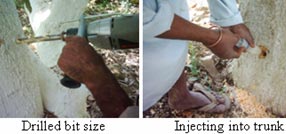
The same pesticides can also be applied by drilling followed by injecting in main trunk and its primary branches deep up to 6".

Sorce: http://www.pakissan.com/english/advisory/aab.monitoringm.device.shtml