.jpg)
Goat Breeding Tips for Livestock Farmers (Urdu)
In order to get maximum meat and milk Beetal, Daira Deen Panah, Nachi, and Teddy Breeds.....

Mango Amazing Facts
The mango is known as the 'king of fruit' throughout the world. The name 'mango' is derived from the Tamil word 'mangkay' or 'man-gay'. When the Portuguese traders settled in Western India they adopted the name as 'manga'.

Pomegranate(Punica granatum) Cultivation and Farming
Pomegranates are fairly drought tolerant and can be grown on either calcareous or acid soils. Climate - Grow best in dry climates with mild winters. Chilling requirement

EU may also ban Monsanto GMO in wake of shocking cancer findings
Russia's consumer protection group, Rospotrebnadzor, said it was halting all imports of GM corn while the country's Institute of Nutrition will be evaluating the results of the study.

Protect Garden Pots during Winter
Many pots, especially ornamental containers that aren’t designed to stand outside in freezing temperatures, need winter protection. Wrap them up in burlap (possibly double layers), and secure tightly at the top and bottom with strong garden string.

Sustainable Agriculture and Fertilizers Practices in Pakistan
Agriculture is the mainstay of Pakistan’s economy. It has a total area of 79.61 million hectare, and the total area used for crop production is only 22 million ha.

Herbs For Winter Windowsill
Growing season is over, do you still find yourself ready to dash out to the garden for some chives, basil or a sprig of thyme...
.jpg)
Claim FREE EBook
Once you subscribe you will get a confirmation email from eagri about joining the mailing list.
Tuesday, March 11, 2014
Pakistan and India trade to be promoted by protecting rights of stakeholders
agrTrade between Pakistan and India should be promoted by protecting the rights of stakeholders particularly the growers. It was recommended by the roundtable conference titled "improving economic governance in agricultural sector through trade liberalisation between Pakistan and India" arranged at the University of Agriculture Faisalabad. 
He quoted the examples of potato which has peak season in August and September in India and in Pakistan it has the peak season in October and November. The conference also recommended that trust deficit between the two countries needs to be bridged through dialogue. The strengthening of the domestic production market is also essential to tap the potential of the sector.
The Vice Chancellor said India is the big market of around one billion of the people. He said the trade with the seasonal window would open up new chapter of progress. He also sought the policy interventions in this regard to flourish the sector in Pakistan. He said India is providing the highest subsidy on the electricity. Even in the Indian Punjab, the subsidy on tube wells is amounting to Rs 1trillion. Syed Babar Ali said we need to tap the potential in flourishing the agricultural sector by promoting the state-of-the-art technologies in the country.
He said China has made tremendous work in the garlic. Our country can do the same. We have to get the benefit from others experience. He said 70 percent of the population is directly or indirectly linked to the agricultural sector that must be strengthened. He also suggested setting up entrepreneurship cell at the UAF in order to equip the youth with the skill and to transform the knowledge into goods and services.
MNA Rana Afzal said the Government is making all-out efforts to strengthen the agricultural sector in the country. He said the recommendations to be made before the government. He said agriculture is the backbone of our economy, contributing 21 percent in the Gross Domestic Product. Tariq Bucha urged the government to take the tangible steps to address the issues of the farming community. He said at least ten percent of the budget must be allocated for the agricultural sector. He said in the process of trade policy formulation, the farmers must be taken on board. ORIC Director Professor Dr Asif Ali, Dr Abdul Ghafoor, Dr Waseem Ahmad, Dr Mubashair Mehdi, Director Ayub Agriculture Research Institute Dr Abid Mehmood, Aiwan-e-Zarat President Dr Sadique Naseem and others also attended the meeting.
Source: Business Recorder

Friday, June 14, 2013
Agriculture in Pakistan: An Overview
1.1 General
The Islamic Republic of Pakistan is an ancient Southern Asian country, bordering the Arabian Sea to the North, with India on the East, Iran and Afghanistan on the west, and China in the north. Pakistan mainly comprises of four provinces, Balochistan, North West Frontier, the Punjab and Sindh Pakistan.

Pakistan's economy is characterized by a predominance of agriculture, a strong industrial base with a large domestic market, and an ample supply of skilled human resources. In general, Pakistan enjoys a well developed physical infrastructure and good communication facilities.
The population in Pakistan, since its inception in 1947, has more than quadrupled to 164.74 million, as of July 2007. The production of wheat, a staple food crop, has increased only three fold. The gap between food supply and demand requires great effort to increase agricultural production while ensuring self-sufficiency in food commodities.
1.2 Agricultural Mechanization
Agriculture plays a pivotal role in Pakistan’s economy. About 22% of the total Gross Domestic Product (GDP), and 44.8% of total employment is generated in agriculture. It also provides a substantial base to Pakistan’s export. Agriculture also contributes to the growth as a supplier of raw materials to the industry, as well as the market for industrial products. Nearly 65.9% of the country’s population living in rural areas is directly or indirectly linked with agriculture for their livelihood. Whatever happens to agriculture, it is bound to affect not only the country’s growth performance but to a large segment of the country’s population as well.
The major crops grown in the country are wheat, rice, maize, cotton, and sugarcane. The area under these crops are 8.35, 2.51, 0.98, 3.2, and 0.97 million hectares, respectively. The annual production of wheat, rice, and maize are 21.61, 5.02, and 2.79 million metric tons, respectively, whereas the annual production of cotton and sugarcane are 14.26 million bales and 47.24 million metric tons, respectively (Anon., 2005-06).

Agricultural mechanization is selective in Pakistan and the only operations that are mechanized are those for which there is a constraint of labor or power, or a combination of both. The effects of mechanization are positive overall: it has not only increased on-farm income and labor productivity but also generated off-farm employment in manufacturing, supply/servicing of agricultural machinery, supply of other inputs and post-harvest handling of increased agricultural production. The most popular forms of agricultural machinery in Pakistan are bulldozers, power rigs, tubewells and tractors with cultivators, wheat threshers, sprayers and trailers. Mould board ploughs and disc ploughs for deep tillage are also gaining popularity.
The bulldozers and power rigs are operated and maintained by the public sector on subsidized rates to farmers whereas tractors and other machines are owned by some farmers themselves. Farmers with medium-sized farms generally share their tractors and other farm machines with their neighboring small farmers on a rental basis. So far, agricultural engineering research has proved to be successful in Pakistan; a number of imported machines were modified by the research institutes and adopted by the farming community. In addition, a few machines/techniques were invented to assist the growers of different crops.
Fact Sheet
Area:
total: 803,940 sq km
land: 778,720 sq km
water: 25,220 sq km
Climate:
mostly hot, dry desert; temperate in northwest; arctic in north
Terrain:
flat Indus plain in east; mountains in north and northwest; Balochistan plateau in west
Elevation extremes:
lowest point: Indian Ocean 0 m
highest point: K2 (Mt. Godwin-Austen) 8,611 m
Natural resources:
land, extensive natural gas reserves, limited petroleum, poor quality coal, iron ore, copper, salt, limestone
Land use:
arable land: 24.44%
permanent crops: 0.84%
other: 74.72% (2005)
Irrigated land:
182,300 sq km (2003)
Natural hazards:
frequent earthquakes, occasionally severe especially in north and west; flooding along the Indus after heavy rains (July and August)
Current environmental issues:
water pollution from raw sewage, industrial wastes, and agricultural runoff; limited natural fresh water resources; a majority of the population does not have access to potable water; deforestation; soil erosion; desertification
Source: http://www.unapcaem.org
Pakistan may harness benefits of agriculture development

This was stated by Professor Dr Iqrar Ahmad Khan, Vice Chancellor, University of Agriculture Faisalabad, while addressing a seminar on changing mindset and building capacity for innovation and commercialisation organised by Office of Research, Innovations and Commercialisation (ORIC) here at New Senate Hall. He said scientific innovation regarding increase in cropping intensity, best agronomic practices, and intervention of GMOs shorter the duration of wheat and cotton crops that enhanced the production to manifold and caused establishment of new cotton mills, ginning factories, textile mills, flour mills, and many of relevant business.
He said "California US produces a range of agricultural commodities, but we remain in a fashion to grow only five crops as the political economy of Pakistan revolves around sugar industry, flour mills, various cartels and vested interests that dictate the affairs. He urged the government for setting up new cattle and grain markets with excellent administrative control so that the rights of producers and livestock farmers could be protected." He emphasised the need for making a platform for innovation and commercialisation at national level so that innovations could pave the way for new business plans.
Source: http://www.brecorder.com
Wednesday, May 29, 2013
Pakistan: Mango export season begins
By Tanveer Sher
Mango export has started in the country on Saturday with an ambitious target of 175,000 tonnes, which is 52 percent higher than the previous season’s target of 115,000 million tonnes.
Export of mango this season is expected to fetch $60 million.
The Ministry of Commerce granted permission to exporters to start export across the country. The objective of the decision was described by exporters on account of avoiding losses through unplanned and premature export of the fruit as witnessed during previous years.
Some 400 metric tonnes of the most favourite fruit of the summer season was airlifted to a number of European and Gulf countries UAE, Qatar, Saudi Arabia, Kuwait, Bahrian, UK and Germany where demand of Pakistani mango is growing with the period of time.
According to All-Pakistan Fruit and Vegetable Importers-Exporters and Merchants Association (PFVA) Chairman Waheed Ahmed, the production of mango is being expected at 1.55 million tonnes, while export target of 175,000 metric million tones mango has been set for this year.

Citing hindrances, which hampered mango exports, he said they include international barriers on trade with Iran, which also declined Pakistan’s exports to that country, as Pakistani banks had stopped trade services with Iran, which previously was importing 30,000 tonnes of mangoes from Pakistan. The country suffered a loss of $10 million for not exporting mangoes to Iran, he said adding that the illegal trade or smuggling via land routes was not benefiting the country in terms of revenue.
Besides, despite of being approved for US market mango exports to the foreign country on commercial basis could not take place due to the condition of treating the mangoes at a radiation plant near Chicago and unavailability of direct air service. Treating and processing the fruit in US, according to him is not only a costlier business but also highly risky for the exporters. Besides, the export of the perishable items via sea routes was also not feasible to the businessmen in horticulture sector due to long transit. The only way out to tap the US market is to provide the radiation facility in Pakistan preferably in Karachi and Multan.
Exports to Australia also could not begin because of quarantine issue. Though Australian quarantine team had visited facilities and orchards in the country to check the quality of the fruit for their market, however no development was made in this regard. The Ministry of Commerce and other concerned authorities should move to approach the authorities in the foreign country to have another highly valued market tapped.
Ahmed said during the current year exporters would focus on exports to Japan, Australia, South Korea, US, Mauritius and Lebanon markets and initiatives would be taken to uplift the quality of Pakistani mangoes to increase exports. Pakistan was presently exporting mango to at least 40 countries of the world including Canada, Germany, UK, France, Italy, Island, Denmark, Holland, Switzerland, Belgium, UAE, Saudi Arabia, Bahrain Kuwait, Singapore, Malaysia, South Korea, Lebanon and others. The varieties those commercially exported from Pakistan are Sindhri, Sunhaira, Fajri, Began Phali, Summar Chaunsa, Black Chaunsa and White Chaunsa.
Owing to the holy month of Ramazan falling in the second week of July, the local and international demand of mango is likely to go up as Muslims across the world are sure to enhance their daily consumption of the most demanding fruit of the summer season.
Responding to a query, he said as pledged by the officials of national flag carrier Pakistan International Airlines (PIA) during a meeting with office bearers of the fruit exporters some one month ago, a pro-active role on its part would be highly beneficial for the export of mango during the current season which may ultimately help realisation of ambitious target of 1.75 million tonnes.
Previous year, PIA had been under criticism for not providing enough space and facilities to mango exporters, but this year it has finally formed a new ‘business strategy’ to lift the fruit with maximum quantity. Providing new equipments and space to its cargo facility, the national flag carrier will be grabbing 25 percent share in the country’s cargo revenue this year. By airlifting maximum cargo for European destinations, the airline would easily be getting substantial revenue from mango exports in 2013, which would enable it to reduce its mounting financial losses.
Source: http://www.dailytimes.com.pk
Thursday, May 23, 2013
Hydroponic Farming: Pakistan Future
Asad Manzoor*
Department of Agriculture & Agribusiness Management, University of Karachi
To defeat food shortages in the upcoming era, Pakistan can use hydroponic farming to overcome crises of food shortage. Hydroponics can be a revolutionary technology for Pakistan to guarantee suitable and sustainable supply of vegetable. It reduces 70 percent to 90 percent less water and reduce cultivated area than irrigated soil and land based agriculture farming and gardening. No water was lost in the ground or absorbed by weeds or lost in evaporation.
With the collaboration of government and private sector, a hydroponic pilot project can be started across the country. The establishment of state-of-the-art greenhouse facility can produce hydroponic tomatoes of all varieties including tangy, elegant, cherry and others. If the hydroponic technology is properly deployed, the country could be a huge power player in the market because nobody else in the region is using high-tech hydroponics.

A high tech hydroponic facility is more expensive to set up than soil farming but once it is set up, operating and maintenance costs were low and the very high and definite yields means that invested money would be recovered in one year.
The world leader’s countries in hydroponics utilize ‘cluster approach’ where land is allocated just for hydroponic farming practiced by different farmers. To develop a viable hydroponics industry, Pakistan urgently needs to improve its infrastructure facilities, such as availability of electricity and land. Greenhouses need a constant supply of power but the situation in Pakistan is not encouraging. By improving electricity facilities and establishing green house a fine chain of hydroponics farm can develop.
With more than 16 million populations, Pakistan needed to boost its agriculture performance, which was low and unpredictable compared to other major agriculture producers. If hydroponics is introduced properly, the country can triple the revenues earned on agriculture exports. The new technology also has a great potential to meet our food requirement.
*Contact: asad@gardener.com
Tuesday, April 30, 2013
Challenges to Biotechnology in Pakistan
By Sayyar Khan Kazi
We are living in an age, where almost all aspects of human life have been revolutionized by the highly sophisticated and advanced technologies. In recent years, we have witnessed on print and electronic media, several scientific endeavors to target innovations and discoveries beyond the boundaries of our planet Earth. Technologically advanced countries such as the USA, European Union, Japan and emerging powers like China and India are beating one another to have speedy access to the mysteries of other planets.
In the quest of unraveling scientific mysteries, several missions from these countries have been launched to Moon, Mars and other planets in order to lead and dictate the terms upon which the human future will rely. Overall, there has been unpreced- ented progress towards industrialization that revolutionized every aspect of human life including medical and health care, aviation, urbanization, infrastructure and agriculture.

Like other scientific disciplines, Agriculture science has received much importance due to the growing needs of expanding populations for more food, feed, fiber and alternative energy resources. In this connection, the advent of modern biotechnology and genetic engineering tools has enabled scientists to manipulate the genetic material of organisms in order to exploit its hidden enormous potential.
In the past two decades, biotechnological tools have brought a paradigm shift in the orthodox and traditional ways and means of improving our various industries, health sciences, environment and agriculture.
For example, in agriculture, since 1995, there has been a sudden boom in the production of transgenic varieties of agricultural crops with enhanced protection from insect pests and diseases. Farmers around the world have gained maximum economic gains from the adoption of these improved crop varieties.
The wide adoption of these improved crop varieties by farmers around the world has resulted a huge economic benefit and positive effects on the environment by less pesticide application.
After the successful production and adoption of disease resistant crop plants, agriculture biotechnology is entering into a new phase of developing second generation transgenic crops that will be able to grow on marginal lands with high water and soil salinity and drought stresses.
It is anticipated that the development of these crop varieties will help to feed the growing populations, particularly in regions of Sub-Saharan Africa and Asia, where majority people are facing hunger, poor quality and malnourished food.
Keeping in view the promising role of biotechnology for securing the future of our coming generations, increasing number of countries, public, private sectors and multinational companies have joined the race and invested billions of dollars for research and development activities.
In some areas, scientists have excelled and accomplished significant targets like crop disease resistance as mentioned above and development of accurate laboratory tools for genetic dissection, diagnosis and research on human genetic diseases.
Pakistan, a developing country is facing multi-faceted challenges including energy crisis, food security, rapid urbanization and declining fresh water resources in the wake of increasing population and the more global phenomenon of climate change.
Like other countries, Pakistan also took a bold step towards adoption of modern biotechnology and started to establish biotechnology centers across the country. In all key national science and technology policies, the role of biotechnology as a potential tool for the growth and socio-economic development has been well acknowledged.
In National science and technology policies launched in 1997 and later in 2009, biotechnology was emphasized one of the priority areas. Pakistan also contributed and pioneered the establishment of an International Center for Genetic Engineering and Biotechnology (ICGEB), initially proposed to be built in Pakistan but later on jointly built in India and Italy.
Despite the initial recognition and quick response, biotechnology did not take roots as an emerging source of socio-economic development in the country. For example, we started research on insect resistant transgenic cotton varieties back in 1995 and developed some transgenic lines but it took almost 15 years to launch legal commercial cultivation of these varieties in 2010.
The other leading cotton producing countries namely USA, China and India adopted and commercialized transgenic cotton varieties in 1996, 1997 and 2002 respectively and farmers in these countries earned huge economic gains.
In addition, we are also lagging behind other countries in development of second generation transgenic crops with improved tolerance to environmental stresses and crops for bio-energy production. The dependency on fossil fuels as energy sources is on the decline because of the enormous potential of bio-feed stocks (crops, trees and grasses) to produce bio-energy products such as ethanol, biodiesel, butanol and petroleum on industrial scale.
Source: The Frontier Post
Monday, April 08, 2013
Agriculture sector: Pakistan seeks enhancement of trade with Malaysia Pakistan

Zafar Bakhtawari, invited President of National Chamber of Commerce and Industry of Malaysia to attend ASEAN Capital Chambers Conference in Islamabad which would be organised by ICCI with the aim to promote mutually beneficial relation between Pakistan and ASEAN member states. ICCI President said that Pakistan produces good quality and affordable agricultural product like Pakistani rice, wheat and mangoes that have great demand in Malaysian markets.
He stressed that there is a dire need to increase export of Pakistani products to Malaysia which would also improve bilateral trade relations further between the two countries. He said that Pakistan has free trade agreement (FTA) with 3 countries that are Malaysia, China and Sri Lanka and Malaysia is the first Muslim country that has signed FTA with Pakistan which also reflects the importance of Malaysia for Pakistan. He further said that Malaysia should also help Pakistan in becoming full-dialogue partner in ASEAN regional bloc. Bakhtawari called on the Malaysian business community to take advantage of the vast Pakistani market and explore investment opportunities in agriculture, construction, livestock and dairy, energy, education, IT and the Halal industry sectors.
ICCI President was of the view that organising joint cultural events was an option which could be used to bring the peoples of both nations closer to each other, as well as exploit untapped bilateral trade and investment potential in both countries. Speaking on the occasion, Ali Al Atas, President of National Chamber of Commerce and Industry of Malaysia said that business community of Pakistan should establish a base in Malaysia for attaining maximum trade benefits in ASEAN countries that would not only help in boosting trade activities but also prove beneficial for introducing Pakistani products in ASEAN countries.
Source: www.brecorder.com/
Major farming systems of Pakistan
Mohsin Tanveer, Asad Saeed, Dr. Ehsan Uallah, Dr. Shakeel Ahmad Anjum
Pakistan is one of most blessed country having all four kinds of seasons with plenty of natural resources. Fortunately, agriculture is backbone of this country and more that 70 % population is associated with agriculture and its products. Out of 70 %, 45 % are involved directly in different farming systems. Farming system is a systematic approach and established way of operating a piece of land with given resources. Farming systems consist of several entrepreneurships like cropping systems, poultry, dairy business, fisheries and bee keeping e.t.c . And very marvellous thing about it is, the waste product of one system can be used as input for other one. There are two dimensions lead to the adoption of any farming system:

2) Availability of resources: Adoption of any farming system depends on availability of resources like arable farming on saline soils need heavy irrigation and if there is less water availability then what benefit will farmer get.
Here are major farming systems of Pakistan
Crop cultivation farming:
Estimated area under this system is 20% of total country area and is practiced by a huge number of farmers in Sindh, Punjab and valleys of KPK and Balochistan. Capital investment is low and is mostly in the form of land, irrigation system, and farm machinery/draft animals etc. Inputs are low to medium and include quality seed, water, fertilizers and pesticides, diesel oil/electricity etc. The 
Fruit tree irrigated farming system (Orchards):
This kind of farming system is practiced by private farmers in patches of variable sizes throughout the plains of Sindh, Punjab and valleys of KPK and Balochistan. Estimated area is 0.6% of total area of the country. However excessive solar radiation, hot desiccating winds, occasional storms and frosts, low rainfall, infertile soils and lack of organic matter in soils are major environmental constraints. Capital investment is low to moderate and is in the form of high quality valuable agriculture land, irrigation system, high quality fruit plants etc. Inputs are low to medium and include quality seed and saplings of most suitable species, irrigation water, fertilizer, pesticides and protection etc. Major crops are citrus, mango, guava, dates, pome grenates, ber, japeni phal, banana, papeeta, loquat, apricot, pears, peaches, almonds, walnuts, plums, and grapes etc. Minor crops are wheat, fodders, vegetables and timber trees etc.
Timber tree irrigated farming system:

Flood irrigation ( Saliable) farming system
It is being practiced on small scale by poor farmers at subsistence level in small pockets along river banks subject to annual inundation and in mountain valleys receiving annual flash floods hill torrents (Northern Balochistan), D.G.Khan, D.I.Khan and Southern KPK. Estimated area is 1% of total area. Irregular floods, low and undependable rainfall, excessive solar radiation, hot desiccating winds, stony/gravelly/light soils, negligible organic matter in soils, infertile soils having low water/nutrient holdings capacities are major environmental constraints.
Sunday, December 23, 2012
Textile ministry joins farmers in denouncing trade with India

Saturday, December 22, 2012
VHT plants installation can boost Pak mango export

Pakistan to import VHT plant from Japan shortly

 The bidders were asked to provide lowest quote for operation and maintenance using the period of 15 years, as the running cost for daily processing of 15 tones of mangoes for a period of 4 months season (120 days), having the net present value using discount rate of 12 percent. The total estimated cost of the plant was Rs 236,170,230.46. It is worth mentioning here that in the absence of required VHT plant, Pakistani mango was not being exported to Japan despite lifting a 16-year-old ban on the import of fruit from Pakistan.
Indian tomatoes flooding Pakistan

 Uppal and C ug said rush of tomatoes to Pakistan is triggered by relatively high prices there because of damage to the crop due to floods in the key producing Sindh region. Chug said the Indian tomato is selling between Rs 25-30(Indian currency) a kg in Pakistan. The price of the same vegetable inDelhi stood from Rs 8-15 per kg in wholesale, traders in the Azadpurmarket said. Uppal said Indian tomato is selling for around USD 350-400(Rs 17,850-Rs 20,400) per tonne in Pakistan. Ajit Shah, president ofMumbai based agriculture export association said around 100-125 tonnesof tomatoes from Nashik is finding its way to Pakistan by road throughWagah.
Sunday, December 16, 2012
AAB monitoring device, cultural practices and chemicals for management of mango tree mortality
By Dr. R. D. Khuhro, Dr. S. M. Nizamani, M. M. Jiskani and M. A. Talpur
Faculty of Crop Protection, Sindh Agriculture University Tandojam
Mango, Mangifera indica is one of the important fruits of Pakistan which is exported to many countries such as Dubai, Saudi Arabia, UK, Germany, France, Holland, Switzerland, Italy, Singapore and Malaysia. It is known as “King of Fruits” and is consumed both by poor and rich people in various forms.
 Mango is
grown is tropical and sub-tropical countries of the world. In Pakistan, it is
grown on large acreages of Sindh and Punjab provinces. There are numerous
varieties of mango, each differing in fruit characters such as taste, flavour,
colour, tinge, shape and size which determine the quality of the fruits and
market value at home and abroad (Jiskani, 2002).
Mango is
grown is tropical and sub-tropical countries of the world. In Pakistan, it is
grown on large acreages of Sindh and Punjab provinces. There are numerous
varieties of mango, each differing in fruit characters such as taste, flavour,
colour, tinge, shape and size which determine the quality of the fruits and
market value at home and abroad (Jiskani, 2002).
 The Asian ambrosia beetle (ABB)
has stout dark reddish-brown body and is reported as pest on broad host range
including woody ornamentals, fruit and nut trees (Atkinson et al., 1988;
Kovach, 1986). Schedl (1962) reported 124 hosts of ABB. The beetle has been
collected and identified from various samples taken from dead or partially dead
mango trees, Shisham, Gold Mohar, Gular, Neem, Eucalyptus, Siris
Albizzia lebbek, rubber plant and Casia fistula from various
ecological zones of Sindh. Only females have wings and disperse with small
movement from infested and dead mango trees, wood logs/pieces and by its own
short movements. These beetles are so tiny that initially attacked trees, don’t
show symptoms.
The Asian ambrosia beetle (ABB)
has stout dark reddish-brown body and is reported as pest on broad host range
including woody ornamentals, fruit and nut trees (Atkinson et al., 1988;
Kovach, 1986). Schedl (1962) reported 124 hosts of ABB. The beetle has been
collected and identified from various samples taken from dead or partially dead
mango trees, Shisham, Gold Mohar, Gular, Neem, Eucalyptus, Siris
Albizzia lebbek, rubber plant and Casia fistula from various
ecological zones of Sindh. Only females have wings and disperse with small
movement from infested and dead mango trees, wood logs/pieces and by its own
short movements. These beetles are so tiny that initially attacked trees, don’t
show symptoms.  In case of severe infestation, the
small pin head sized holes appear with the inside and outside movement of beetle
on bark. The beetles excavate galleries in the branches, trunks, roots and
twigs. The beetles introduce fungi complex in the mango tree and lay their eggs
in clusters. In some mango trees no holes in bark appear but black spots on the
basal parts of trunks are present. After cutting those barks, the light yellow
paste with bad odour watery secretion flows. The beetles are also present in
infested black basal part of the trunk.
In case of severe infestation, the
small pin head sized holes appear with the inside and outside movement of beetle
on bark. The beetles excavate galleries in the branches, trunks, roots and
twigs. The beetles introduce fungi complex in the mango tree and lay their eggs
in clusters. In some mango trees no holes in bark appear but black spots on the
basal parts of trunks are present. After cutting those barks, the light yellow
paste with bad odour watery secretion flows. The beetles are also present in
infested black basal part of the trunk.  The gum like secretion/drops
commonly known as gummosis oozes out from holes of trunks/branches of mango
trees infested with beetle. The “C” shaped, legless, white grubs of beetle are
found feeding on inner darkened portion of barks. From the infested trunk of the mango
tree, the frass of the beetle is pushed out of galleries, in a typical
tooth-pick fashion.
The gum like secretion/drops
commonly known as gummosis oozes out from holes of trunks/branches of mango
trees infested with beetle. The “C” shaped, legless, white grubs of beetle are
found feeding on inner darkened portion of barks. From the infested trunk of the mango
tree, the frass of the beetle is pushed out of galleries, in a typical
tooth-pick fashion.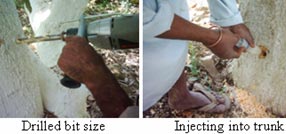
Sorce: http://www.pakissan.com/english/advisory/aab.monitoringm.device.shtml
Mango Varieties
Flesh firm, fibreless with pleasant flavour and sweet taste. Juice moderately adundant. Fruit quality good, keeping good quality. Ripening season in August.
 |
| Season: July -
September Origin: Rahim Yar Khan & Multan Color: Gold Flavor: Slight perfume Fiber: 17.2 - 27.3% Sugar Content: 18 - 22% Pulp Gravity: Heavy Moisture Content: 78% after ripening; 81% before ripening Weight: 1-2.3 Pounds Relative Humidity: 85% |
Sindhri Mango:
Leading variety of Sind. Fruit shape ovalish long, size large, skin colour lemon yellow when ripe, pulp colour yellowish cadium, texture fine and firm fibreless, stone medium sized, flavour pleasantly aromatic and taste sweet.
 |
| Season: Mid-May to
mid-July Origin: Mir Pur Khas Color: Gold Flavor: Slight Perfume Pulp Gravity: Medium Fiber: 3 - 5% Moisture Content (average): 79% after ripening; 18% before ripening Weight: Average 1 - 3.5 pounds Relative Humidity: 85% |
Other Varieties of Mango
Langra:
It has originated as a superior chance seedling near Benares. Size medium to large, ovate, base round to slightly flatten, shoulders equal. Beak minute but distinct, sinus slight to absence, skin green and thin, flesh fibreless, yellowish brown in color, scented, highly melting, very sweet. Stone very small, flattened, oval. Weight of an average fruit is about ¼ kg. Fruit quality very good, bearing heavy. Season (Early to mid Season). 1st to 3rd week of July. Heavy yielder.
Amman Dusehri:
It derives its name form village between Lucknow and Malihabad where it was originated as a superior chance seedling. Size small to medium, oblong, ventral, shoulder higher than dorsal, beak and sinus absent, color yellow when ripe, skin thin, pulp fibreless, flesh firm, very sweet, flavor nice. Stone very small, oblong, variety good to very best, bearing heavy, mid season (July), keeping and peeling quality good.
Alphanso, Bombay:
This is a leading commercial variety of Bombay State and is one of the best in India. Because of its better adaptability to humid climate it has not been able to maintain its esteemed position in the dry districts of Pakistan. The Alphanso is successful in some districts of Sindh. Size medium, ovate, oblique, base obliquely flattened, Ventral structure boarder and much higher than dorsal, beak just a point, sinus not prominent, color of the ripe fruit yellow or brownish yellow, skin thin, pulp yellowish brown, flesh firm, taste very sweet, flavor excellent, almost fibreless. Fruit quality is good. Mid season variety harvested in July.
Sammar Bahisht:
It has originated as a superior chance seedling in Muzaffernager U.P. It got its name because of its pleasant flavor. Fruit medium, base slightly flattened, shoulders equal, sinus very light, beak point prominent, skin greenish yellow, thin, pulp yellow, very sweet, sparsely fibrous, flavor pleasant to delicious. Stone medium and oblong, oval. Quality of the fruit is very good, keeping and peeling qualities well. Ripening season July-August.
Fajrikalan:
It has originated as superior chance seedling in Bihar and gor its name after the name of lady Fajri who selected and brought up its trees. Size big, oblong, obliquely oval, base rounded, shoulder unequal, with ventral higher than the dorsal, beak distinct, sinus very shallow with rounded apex. Skin thin, pulp color pale, fibreless, taste sweet with pleasant flavor. Juice moderate to abundant. Stone large, oblong. Fruit quality good to very good bearing late season August, Keeping quality good.
Muhammadwala:
Size small to medium, skin thick, yellow brown, pulp sweet, juicy, stone medium sized, fiber very little. Very hard variety. Season early August.
Sammar Bahisht Chausa:
It is originated as choicest seedling in a village Chausa in Malihabad, Tehsil of Lucknow. It is also known as "Kajri" or "Khajri". There is resemblance between the foliage of Fajri and this variety but there are marked difference in fruit shape and quality. Fruit medium to large ovate to oval, base obliquely flattened, ventral shoulder raised than the dorsal, beak distinct, sinus shallow, apex round, skin medium in thickness, smooth, flesh firm, fibreless with pleasant flavor and sweet taste. Juice moderately abundant. Stone somewhat large oblong. Fruit quality good, bearing heavy, keeping quality medium to good. Ripening season in August (late).
Rataul (Anwar):
It has originated as a chance seedling in "Shohra-e-Afaq" Garden in Rataul. Now is has become popular in mango growing areas of Punjab because of its high flavor. Fruit medium, ovate, base flattened with equal shoulders, which are rounded, beak not prominent, absent in some cases, sinus absent, and apex round. Skin medium thick. Flesh firm, fibreless, flavor very pleasant, with very sweet taste. Juice moderately abundant. Some medium oval. Fruit quality very good. Ripening season in July (Mid-Season). Keeps well in storage.
Bangapali:
Another variety of Sindh. Fruit shape is obliquely oval, Size is big, length about 14 cm. Breadth 9.1 cm Thickness 8.2 cm. Weight 22.0 oz. Base obliquely flattened. Cavity not prominent. Stalk inserted obliquely. Shoulders ventral typically razed, broader and much more higher than dorsal. Back almost rounded. Skin color dark green and glazy when unripe. Yellowish light green with very light crimson patches when ripe. Surface smooth, shining. Dots small distinct. Glands small, crowded.
Neelam:
Quality variety of Sindh. Fruit shape ovate, size small, length 7.7cm breath 5.9cm thickness 5.6cm weight 5.0oz. The base is rounded. Stalk inserted squarely. Cavity slight to absent, Shoulders unequal. Ventral is higher than dorsal, back rounded. Sinus slight to shallow, Beak acute to obtuse. Apex rounded, Skin color sea green when unripe & yellow with reddish tinge when ripe. Surface smooth. Small dots with numerous small glands.
Mango Export 2000-2001
Th etotal production (estimated) is 988 thousand tonns. The total export during this is 183 thousand tonns with value of 3,453 million ruppees.
Source: Source: Ministry of Food, Agriculture and Ministry of Food, Agriculture and Livestock, Federal Bureau of Federal Bureau of Statistics
Wheat: Planning for better yield (بہتر پیداوار کے لئے منصوبہ بندی: گندم)

The Main land China brings 30 million hectares the largest are in the world followed by Russian Federation, India, USA, Australia, Canada, Turkey and Pakistan.
As far as the highest yield is concerned, France produces 7200 kg per hectare. Who leads other countries because it has much longer growing season of winter wheat? It is rather more appropriate to compare our wheat grain yields with countries of similar climatic and eco-zones, like Mexico and Egypt. Their yields are much higher owing both genetic constitution of cultivars and environment provided to them to express their biological potential.
Since Mexico and Pakistan are located in analogous ecological zones therefore, introduction of Mexican varieties in the country in sixties verities in the country in sixties ushered an era of green revolution. But unfortunately the pace of development could not be maintained for long and we now lag much behind the Mexican yields, who have gone for ahead of us producing 3900 Kg. of wheat grain per hectare as compared to 2491 K. for us in the year 1999, the best season. According to FAO statistics for 1995, among spring wheat growing countries Egypt has fantastic yield by producing 5422 kg. of grain per hectare where as Indian Punjab producing 4090 kg. and even India leads us in average yield by producing 2559 kg. notwithstanding three times largest area as compared to ours.
In our country wheat is cultivated largely (80 per cent), in irrigated areas whereas, rest in rain-fed. The yield and production in latter part of the country is predominantly controlled by rains during growing season, which usually are erratic. Hence yields are much lower during season of low precipitation.
There are of course three kinds of wheat cultivars, the long duration, the medium and short duration varieties. The wheat yields usually start declining after 20th Nov sowing at the rate of 20 kg per day.
Hence efforts must be made to plant it at optimum time. In cotton areas the sticks are by and large used as fuel in domestic house hold. Big heaps of cotton sticks can be seen along the roadside and in villages.
There is a great need to educate growers as to how much yield is last due to burning of sticks. So as to restores the soil fertility at least 80 per cent sticks may be buried in soil. In order to enhance the decomposition half a bag of urea per acre may be incorporated in the soil after the stick burial.
In view of numerous benefits through the addition of organic matter from cotton sticks, may be made mandatory for each farmer. In case wheat sowing is delayed owing to late maturity of cotton, wheat may be sown in standing crop, if there is low or no incidence of weeds. However in rice tract wheat should be sown on proper time immediately after crop harvest. In rice zone a sizable area must be brought under this season legumes, the chickpeas and lentils. It is of course not so difficult to reap their yields up to 1000 kg per acre, which will bring more finances to the growers as compared to raising wheat.
Adequate quantity of nitrogen, phosphorus and potash may be applied to harvest maximum grain. If phosphorus is added adequately it will not only help to realize good harvest, the following crop of cotton shall utilize the remaining residual phosphorus, without adding more of this element to cotton.
In my opinion there are three main factors, which largely contribute towards low wheat yields, the optimum time of sowing, prevalence of high intensity of weeds, imbalance use of fertilizer. The low level of organic matter is also important for holding the yield. In irrigated areas the crop is generally sown either after the harvest of cotton or paddy.
In most of the cases it is customary that farmers neither add organic matter nor farmyard manure to maintain fertility, thus resulting in low yields. In order to sow wheat at optimum time the cotton breeders in collaboration with cotton agronomists must try to reduce the life span of cotton crop without hampering the yield and deteriorating the quality of lint. In this way not only have substantial saving on the management of cotton but also timely sowing of wheat to realize maximum yields. As far as weeds are concerned it is estimated that decline in wheat yield ranges from 15 to 40 per cent or even more in some cases, which is indeed a great loss towards food self-sufficiency.
As my experience goes tit is much worst in certain localities where it appears as if wheat is an unwarted and obnoxious plant. It is in fact a glaring negligence on the part of extension workers and the grower himself.
The extension workers with the help of farmers may try to delineate the areas of high infestation of "Dumbi Sitti" and wild oats.
The farmers in such areas may be advised to control them through agronomic practices or herbicide treatment or removing the weed plants just after earring because at that stage it is easy to differentiate between both the weed and wheat plants.
If these weeds are not controlled now they will spread like a wild fire in coming years in whole of wheat areas. Thee weeds have capability to produce large quantities of seed, which is always shed before wheat harvest. Henceforth infestation increases at an alarming pace. These two weeds along with "It Sit" can be used as biological warfare in agriculture. On the other hand in barani areas "Pohalli" is quite a common weed, which can be easily seen while travelling by air, road or rail after the harvest of wheat.
The abundance of this weed undoubtedly is a main factor for low yield in the area. The Pohalli remain green much after harvest of crop. At that time it is an appropriate time to launch a campaign to eradicate it by uprooting and burning. Two or three exercise will help to whip out the weed in barani areas. Henceforth this year may be declared a Pohalli eradication year. The road sides and sides of rail tracks may also be cleared of it.
The pace of yield increase per hectare during past twenty years has been awfully poor rather frustrating since 1980 to 01. The population growth however, over whelmed the increase in yield per unit area therefore; the enlarged demand of wheat consumption was met by bringing more area under crop.
Which certainly is not a good omen. But for how long increase in area under crop shall come to our rescue. This problem has to be tackled through serious and wise planning and execution.
First of all we shall have to get rid of non-technocrats from lowest level to highest in the ministry of food, agriculture and livestock and induct able selfless agricultural scientists but not the pseudo ones. More funds have to be infused for research and transfer of technology. At the same time we must motivate the general public to diversify the so-called dietary pattern, is greatly imbalanced, which required to be substituted by balanced through intake of nutritive food, so as to reduce unnecessary burden on wheat. Besides this we must substantially boost yield per unit area. Thus placing this area under oil seeds, vegetables, fruits, pulses, and flowers. Also considerable area may be brought under fodder to raise ore animals for milk and meat production. Last but not the least we ought to arrest population growth.
With the improvement in agronomic practices we must try to equate with Egyptian or across the Punjab wheat yields in less than three or at the most five years.
Storage facilities: There are many stored grain pests, which destroy a considerable quantity of produce while in store in villages. Efforts may be made to eliminate the losses. If these losses are controlled it is possible that we may not have to import food grains any longer.
Courtesy Daily Dawn, 10 December 2001
Wheat
 Wheat (Triticum spp.) is a worldwide
cultivated grass from the Fertile Crescent region of the Near East. In 2007
world production of wheat was 607 million tons, making it the third
most-produced cereal after maize (784 million tons) and rice (651 million tons).
Wheat grain is a staple food used to make flour for leavened, flat and steamed
breads, biscuits, cookies, cakes, breakfast cereal, pasta, noodles, or biofuel.
Wheat is planted to a limited extent as a forage crop for livestock, and the
straw can be used as fodder for livestock or as a construction material for
roofing thatch. Wheat (Triticum spp.) is a worldwide
cultivated grass from the Fertile Crescent region of the Near East. In 2007
world production of wheat was 607 million tons, making it the third
most-produced cereal after maize (784 million tons) and rice (651 million tons).
Wheat grain is a staple food used to make flour for leavened, flat and steamed
breads, biscuits, cookies, cakes, breakfast cereal, pasta, noodles, or biofuel.
Wheat is planted to a limited extent as a forage crop for livestock, and the
straw can be used as fodder for livestock or as a construction material for
roofing thatch. | ||||||||||||||||||||||||||||||||||||||||||||||
|
||||||||||||||||||||||||||||||||||||||||||||||
| ||||||||||||||||||||||||||||||||||||||||||||||
Inventory of the Plants of Pakistan

The primary goal of this project is a comprehensive inventory of the plants of Pakistan. This will be accomplished by 1) completion of the remaining family treatments of the published Flora of Pakistan, and 2) development of a web-accessible searchable relational database of all plant species in Pakistan. Eventually, we hope to create a revised, synopical Checklist of the Plants of Pakistan in both electronic and published form. This project will result in a complete modern Flora of approximately 6,000 species from a large, relatively poorly known region of South Asia, and the first complete floristic database for the region.
Overall institutional support for this project comes from the University of Karachi, Pakistan, and the Missouri Botanical Garden, St. Louis. Support for the completion of the published Flora of Pakistan has been provided by the US National Science Foundation, Division of Environmental Biology, Biotic Surveys & Inventories Program, through two grants, most recently DEB-0316828. Support for development of the electronic database and website has been provided by a grant from the US Department of Agriculture, Foreign Agricultural Service, Research & Scientific Exchanges Division, Scientific Cooperation Research Program. Additional support for this project was provided by grants to the Missouri Botanical Garden from the Andrew W. Mellon Foundation and from the Taylor Family Fund. The project investigators gratefully acknowledge the generous support for the Pakistan project from these institutions. For more information about this project, please contact Peter Hoch (peter.hoch@mobot.org).
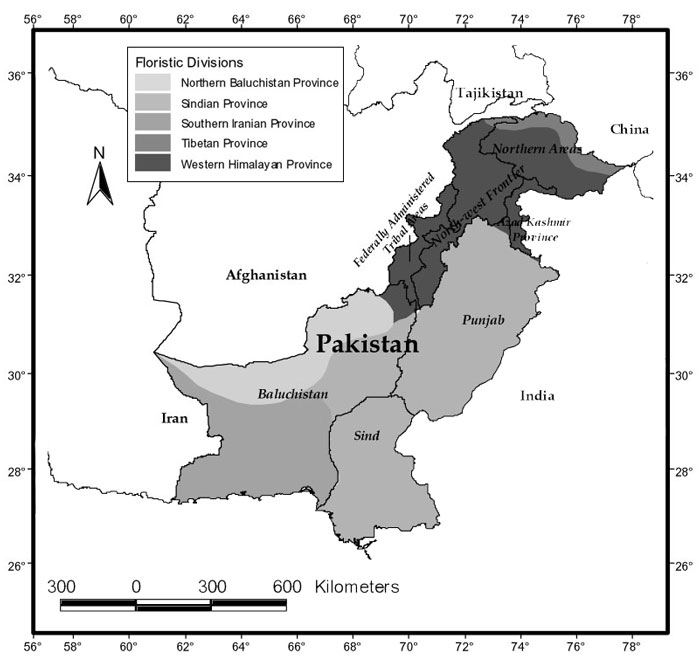
Although established as an independent country only in August 1947, Pakistan occupies a position of great geostrategic and biogeographical importance, bordered by Iran on the west, Afghanistan on the northwest, China on the northeast, India on the east, and the Arabian Sea on the south (Fig. 1). Lying between 23-37° N and 61°-81° E, Pakistan has a total land area of 804,152 square kilometers, about twice the size of California. The altitude ranges from sea level to 8,611 m (at K2, the second highest peak on Earth), and temperature varies from well below zero in the high, glacier-clad mountains to 52°C (125°F) at Sibi in the plains. Mean annual precipitation ranges from c. 50 mm at Nok Kundi in Baluchistan to 2032 mm in the monsoonal uplands of Kashmir (Ali 1978). This great variation in elevation, temperature, precipitation, and other physical parameters has resulted in a diversity of biotic communities, and a relatively rich flora of at least 5,700 species of flowering plants (Ali 1978).
Pakistan sits astride one of the major disjunctions in the biota of southern Asia, with the line of demarcation running along the western edge of the Indus Basin and the deep dry upper Indus valley of Kohistan (Frodin 1984). This biogeographic disjunction was the mutual boundary between Boissier's Flora Orientalis (1867-1888) and Hooker's Flora of British India (1872-1897), the two standard floras of the late nineteenth century for Southwest and South Asia, respectively. One of the modern floras of the region, the Flora Iranica, initiated in 1963 by K. H. Rechinger (Vienna), follows this eastern boundary of Boissier's classic work, and so includes Baluchistan and the N.W.F. Provinces of Pakistan. The Flora Iranica does not, however, treat plants of the rest of Pakistan, including the very rich northeastern areas.

Pakistan has a human population of some 141,500,000 (July 2000 est.), according to The World Factbook 2000 (www.odci.gov/cia/publications/factbook/geos/pk.html). Because some areas of Pakistan, especially the arid southwest (Baluchistan) and the mountainous north, are inhospitable and sparsely populated, this large population is heavily concentrated in the Indus Valley. The environmental impacts of this huge human population and the very long history of human occupation of the Indus Valley (home to a highly developed urban civilization at least 5,000 years ago) present special challenges to the government. Many of the most pressing environmental issues in Pakistan involve water, i.e., water pollution from raw sewage, industrial wastes, and agricultural runoff, and shortages of potable water for a majority of the populace. The other major environmental problems – deforestation, soil erosion, and desertification – are also closely tied to water use and availability.
Stewart (1972, 1982), Hedge (1991), and others have reviewed the history of botanical exploration in Pakistan fairly extensively. Starting in 1820 with an expedition to Kashmir by William Moorcroft, many European (mainly British) botanists visited Pakistan, eventually collecting plants from virtually all parts of the country. The coverage was modest in the mountainous areas in the north, inhabited by often-hostile tribes and naturally inhospitable as the nexus of the Hindu Kush, Karakoram, and Himalayan ranges. The results of these collecting activities contributed to the two great floras of the region, the Flora Orientalis (Boissier 1867-1888) and the Flora of British India (Hooker 1872-1897). Collecting continued in the early twentieth century, rendering much of those great 19th century floras out-of-date. One important aspect about the collections made in Pakistan prior to the country's establishment in 1947 is that virtually all of them were housed either in Europe (mainly BM, E, and K) or in India, at Calcutta or Dehra Dun, in both cases inaccessible to botanists in Pakistan (Stewart, 1972). The largest plant collection in Pakistan in 1947 was that developed by Ralph Stewart at Gordon College in Rawalpindi.
As the new nation of Pakistan began to develop universities and a scientific infrastructure, it became obvious that a first priority in the area of botany would be production of a Flora for the country. In 1960, Stewart retired from active work at Gordon College, and turned over his herbarium, then numbering about 50,000 specimens, to his collaborator Prof. E. Nasir. The "Stewart Herbarium" was later presented as a gift to the nation, and formed the nucleus of the National Herbarium of Pakistan (Ali & Ghaffar 1991). This collection, and those established at other institutions, particularly at the University of Karachi by S.I. Ali, provided the necessary foundation for writing the Flora. During the 1960's, the U.S. Department of Agriculture developed a scheme to use PL480 funds, which had to be spent within the country, to collect plants in Pakistan. That program ultimately did not survive, but the funds were still available and a new proposal was developed. The Flora of Pakistan project was initiated in 1968, with Nasir and Ali appointed as Joint Editors. They set to work immediately, and in 1970, the first fascicle (Flacourtiaceae) of the Flora appeared. Another of the early publications of the project was the "Annotated Catalogue of Vascular Plants of West Pakistan and Kashmir" by Stewart (1972), intended as a preliminary checklist of the plants of the region and a guide to the developing Flora project. Stewart included 5,783 species in his catalogue, and Flora treatments published subsequently have not changed that overall estimate appreciably (Ali 1991), although new treatments for individual genera/ families differ, sometimes substantially, from those by Stewart.
In 1999, at the XVI International Botanical Congress, S.I. Ali (University of Karachi and principal editor of the Flora of Pakistan) proposed a plan to Peter H. Raven (Missouri Botanical Garden) for completing the Flora in five years with the Missouri Botanical Garden as co-publisher. Following negotiations, in February 2000, the University of Karachi and the Missouri Botanical Garden signed an agreement to co-publish the remaining volumes of the Flora of Pakistan over a period of five years. This initiative has several strong positive features:
- It will complete a Flora of an important and insufficiently known region;
- It connects geographically and floristically with the Flora of China project headquartered at the Garden (many taxa in common, often requiring a coordinated approach);
- It provides the best opportunity to develop a database of plants for south Asia, which can connect with comparable databases for China and elsewhere and can serve Pakistan as an important biodiversity management tool; and
- It will provide a source of new collections from that region, which is poorly represented in American herbaria.
The third "product" intended to derive from this project is the Checklist of the Plants of Pakistan. Just as Stewart's (1972) "Catalogue" was intended to summarize existing data and stimulate new research, so too do we intend for the Checklist to be a stimulus for future work. The format of the Checklist will be similar to that of the recent Catalogue of the Vascular Plants of Ecuador (Jørgensen & León 1999) and will present a synopsis of the entire flora of Pakistan. For each accepted name, this format will include author and citation, synonyms, abbreviated distribution statement, one verified voucher (and/or the type specimen, if from Pakistan), and references to major literature on the taxon. Introductory chapters will briefly summarize information about Pakistan's geology, paleoclimate, geography, climate, vegetation, and history of exploration. It will be based on the Pakistan Database, and will be available both electronically and as a published volume. However, all treatments will be reviewed and compared with current taxonomy and nomenclature, especially by reference to treatments in Flora Iranica, Flora of China, and recent monographs. Whenever possible, the family treatments for the Checklist will be sent to specialists for review. This type of revision will be particularly important for fascicles published early in the Flora project, and for groups in which current research is particularly active.
The database for the Flora of Pakistan project is being developed on the same model as that for the Flora of China project (http://flora.huh.harvard.edu/china). Ali and colleagues will provide the remaining treatments (starting with Iridaceae) as Word documents, which will be parsed (paragraph-delineated) and converted into an Excel database. All earlier treatments will be scanned using an optical character reader (OCR) and saved as Word documents, edited for accuracy against the original, parsed, and converted. Each element of the Flora treatments – family descriptions, notes, and keys; generic descriptions, synonymies, notes, distribution, and keys; and species names, place of publication, types, synonymies, notes, indigenous uses, distribution, phenology, cited specimens, and illustrations – will be included in this interactive database. Ultimately, users will be able to search the database using a variety of queries. More than half of all species in the Flora of Pakistan are illustrated, and these drawings and photographs will be scanned and made available electronically.