.jpg)
Goat Breeding Tips for Livestock Farmers (Urdu)
In order to get maximum meat and milk Beetal, Daira Deen Panah, Nachi, and Teddy Breeds.....

Mango Amazing Facts
The mango is known as the 'king of fruit' throughout the world. The name 'mango' is derived from the Tamil word 'mangkay' or 'man-gay'. When the Portuguese traders settled in Western India they adopted the name as 'manga'.

Pomegranate(Punica granatum) Cultivation and Farming
Pomegranates are fairly drought tolerant and can be grown on either calcareous or acid soils. Climate - Grow best in dry climates with mild winters. Chilling requirement

EU may also ban Monsanto GMO in wake of shocking cancer findings
Russia's consumer protection group, Rospotrebnadzor, said it was halting all imports of GM corn while the country's Institute of Nutrition will be evaluating the results of the study.

Protect Garden Pots during Winter
Many pots, especially ornamental containers that aren’t designed to stand outside in freezing temperatures, need winter protection. Wrap them up in burlap (possibly double layers), and secure tightly at the top and bottom with strong garden string.

Sustainable Agriculture and Fertilizers Practices in Pakistan
Agriculture is the mainstay of Pakistan’s economy. It has a total area of 79.61 million hectare, and the total area used for crop production is only 22 million ha.

Herbs For Winter Windowsill
Growing season is over, do you still find yourself ready to dash out to the garden for some chives, basil or a sprig of thyme...
.jpg)
Claim FREE EBook
Once you subscribe you will get a confirmation email from eagri about joining the mailing list.
Sunday, December 16, 2012
New Agri-Technology

New Delhi: In Kerala, where paddy cultivation is going out of favour because of labour problems and high costs, the novel System of Rice Intensification’ (SRI) has shown the potential to rehabilitate this crop.
This innovative technique ensures substantially higher productivity and lower input use. The SRI system has, in fact, proved its utility in many other regions as well, spanning Sikkim in the north-east to Tamil Nadu in the south.
The environment-friendly SRI method of growing rice involves transplanting relatively young paddy seedlings (eight to 10 days old instead of usual 20 days or more), along with the soil that contains their roots. The spacing between plants and rows is kept relatively wide at around 25 cms to provide room for the robust growth of both root and plant.
Plant nutrients are supplied largely through farm-yard manure, supplemented with need-based fertiliser applications. The most significant aspect of SRI is that the fields are not kept submerged under water all the time, as is usual in rice farming, but are allowed to remain just wet without flooding.
The success of SRI technology in most places where it has been tried in the past few years has led to its promotion in a big way by Krishi Vigyan Kendras (KVKs or agricultural science centres) and other farm research bodies under the Indian Council of Agricultural Research (ICAR). What makes the SRI method an instant hit with paddy growers is the saving of almost all key inputs (water, seed, fertilisers, pesticides and labour), and a perceptible spurt in crop productivity, which has, of late, tended to stagnate at many places.
The saving on water, which is rapidly turning scarce in most paddy-growing tracts, can be 30 to 40 per cent or more; that of costly seeds over 50 per cent. The reduction in the requirement of other inputs varies according to field conditions.
Higher crop yields in SRI fields are attributed to several factors. Since the seedlings are planted along with the soil in which these are growing, it helps the undisturbed roots to develop more profusely and enables it to tap more nutrients from the soil. This, in turn, facilitates a larger number of tillers (shoots) per root-system, vigorous plant growth and, more importantly, longer panicles (ear-heads) to accommodate more grain per plant.
Moreover, the fact that the seedlings are planted in wide-apart rows makes it easier for farmer to remove weed and other rogue plants that normally compete with the main crop for extracting nutrition from soil.
SRI fields also have a lower incidence of pests and diseases, mainly on account of lower humidity because the fields are not kept inundated. Overall crop yields have been found to surge by anywhere between 20 and 100 per cent over those obtained with normal cultivation practices.
The introduction of the SRI technique in different states has shown that it works well with both high-yielding varieties and local varieties of paddy. In east Sikkim, for instance, where farmers tend to grow only traditional varieties, such as Attey, Krishnabhog and Dudhetulsi, the new method enabled farmers to bag, on average, over 23 quintals of grain per hectare, against 19.6 quintals with conventional method, in kharif 2009-10. Farmers earned an average net return of around Rs 25,550 per hectare, more than double the production cost of Rs 10,950, according to sources in the KVK run by the ICAR Research Complex for the north-eastern hilly region, located in East Sikkim district.
In the Nellanad area of Thiruvananthapuram, where the SRI technology has been introduced by the local KVK in collaboration with the Coimbatore-based Tamil Nadu Agricultural University, farmers have reportedly reaped a paddy harvest of nearly 7 tonnes per hectare, against the state’s average crop productivity of 3 to 3.5 tonnes a hectare. This has spurred the state government to include the promotion of SRI in its overall agricultural development policy. Kerala’s example can surely be emulated elsewhere.
Similar encouraging results have been reported from Tamil Nadu’s key paddy belt in the Mettur dam command area where the uncertainty over the release of canal water from this dam has been posing problems for paddy growers. With the SRI technique, farmers can manage comfortably with whatever water is available.
Courtesy: Business Standard

New farming techniques produce more food, while protecting land in Nicaragua
New farming techniques produce more food, while protecting land in Nicaragua
 Indigenous people in Nicaragua's Rio Coco region bring their harvest downstream.
Photo: ACT Alliance/CWS/Don Tatlock
That was the message from a delegation from Nicaraguan organization Christian Medical Action, AMC, in a recent visit to partner Church World Service (CWS), a longtime supporter of AMC's work in the Central American country and a member of ACT Alliance. The delegation was in Washington, D.C. to attend a conference.
Francisco Gutierrez, programme officer and a former executive director of AMC, told of how in 2005, 30 children in the Rio Coco area of northern Nicaragua faced starvation because rats had eaten all the food. AMC intervened with emergency food and also provided seeds, animals and technological assistance to struggling families in the community. As a result, malnourished children at risk for permanent physical and mental developmental defects have regained their health, and nutritionally diverse crops are thriving on farms and in family gardens.
AMC leaders attribute the progress toward food security in a region challenged by climate change and weather disasters – like Hurricane Mitch in 1998 – to the families' embrace of programs aimed at training, teaching and transfer of technology.
"I have learned that there is a lot of capacity and knowledge in this population," says Gutierrez. "The people here only need support so that they can develop their capabilities."
That is precisely what is happening at six CWS-supported demonstration farms, where some 5,000 people already have learned sustainable farming techniques ranging from organic pest control to crop diversification and soil conservation. These model farms include food storage facilities, a water source, seeds and tools, animal spaces, and plots for growing fruit, grains and vegetables.
Program participants then share what they already know from experience and what they have learned at the demonstration farms with other farmers and gardeners in their communities and beyond. AMC also promotes sustainable agriculture techniques in Matagalpa, an impoverished area of central Nicaragua. Already, the expertise gained by people in the Matagalpa communities is being transferred to indigenous people along the Rio Coco river who own land but lack the techniques necessary to get the most from that valuable resource. The Rio Coco program, implemented by AMC, is supported by CWS through the Foods Resource Bank.
"These demonstration farms empower communities to draw upon their own knowledge to help themselves," says Gutierrez. The net result is the kind of broad information and experience sharing that is reaching beyond either Matagalpa or Rio Coco to help AMC and its partners in other areas develop a regional strategy for improving food security.
Some 80 landless participants in the program in Matagalpa are working land owned by AMC, under a program that facilitates their actual purchase of the land over a period of years. The land grant program is also supported by CWS CROP Hunger Walk funds. Gutierrez says that several families actually have completed the purchase of their land over the past seven years.
With the greater crop yields resulting from smarter farming comes a larger amount of surplus produce not needed for family meals that could be sold to earn income to pay for other necessities. To that end, Gutierrez says AMC is lobbying the government to support efforts to help people get their goods to market for sale.
And what would success look like for communities participating in the program? The security of access to nutritionally diverse food throughout the year, the ability to sell surplus food at a fair price, and increased awareness of the need to protect the environment even as the personal and economic needs of families and communities are being met.
Inventory of the Plants of Pakistan

The primary goal of this project is a comprehensive inventory of the plants of Pakistan. This will be accomplished by 1) completion of the remaining family treatments of the published Flora of Pakistan, and 2) development of a web-accessible searchable relational database of all plant species in Pakistan. Eventually, we hope to create a revised, synopical Checklist of the Plants of Pakistan in both electronic and published form. This project will result in a complete modern Flora of approximately 6,000 species from a large, relatively poorly known region of South Asia, and the first complete floristic database for the region.
Overall institutional support for this project comes from the University of Karachi, Pakistan, and the Missouri Botanical Garden, St. Louis. Support for the completion of the published Flora of Pakistan has been provided by the US National Science Foundation, Division of Environmental Biology, Biotic Surveys & Inventories Program, through two grants, most recently DEB-0316828. Support for development of the electronic database and website has been provided by a grant from the US Department of Agriculture, Foreign Agricultural Service, Research & Scientific Exchanges Division, Scientific Cooperation Research Program. Additional support for this project was provided by grants to the Missouri Botanical Garden from the Andrew W. Mellon Foundation and from the Taylor Family Fund. The project investigators gratefully acknowledge the generous support for the Pakistan project from these institutions. For more information about this project, please contact Peter Hoch (peter.hoch@mobot.org).
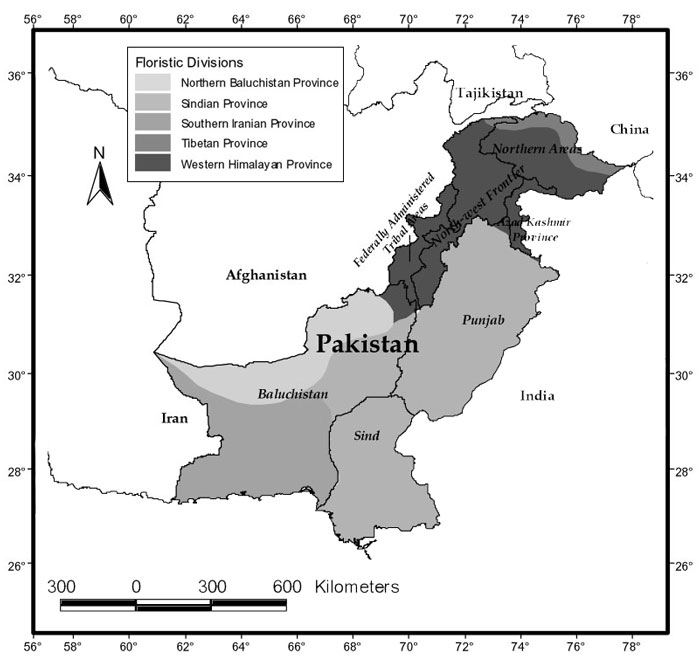
Although established as an independent country only in August 1947, Pakistan occupies a position of great geostrategic and biogeographical importance, bordered by Iran on the west, Afghanistan on the northwest, China on the northeast, India on the east, and the Arabian Sea on the south (Fig. 1). Lying between 23-37° N and 61°-81° E, Pakistan has a total land area of 804,152 square kilometers, about twice the size of California. The altitude ranges from sea level to 8,611 m (at K2, the second highest peak on Earth), and temperature varies from well below zero in the high, glacier-clad mountains to 52°C (125°F) at Sibi in the plains. Mean annual precipitation ranges from c. 50 mm at Nok Kundi in Baluchistan to 2032 mm in the monsoonal uplands of Kashmir (Ali 1978). This great variation in elevation, temperature, precipitation, and other physical parameters has resulted in a diversity of biotic communities, and a relatively rich flora of at least 5,700 species of flowering plants (Ali 1978).
Pakistan sits astride one of the major disjunctions in the biota of southern Asia, with the line of demarcation running along the western edge of the Indus Basin and the deep dry upper Indus valley of Kohistan (Frodin 1984). This biogeographic disjunction was the mutual boundary between Boissier's Flora Orientalis (1867-1888) and Hooker's Flora of British India (1872-1897), the two standard floras of the late nineteenth century for Southwest and South Asia, respectively. One of the modern floras of the region, the Flora Iranica, initiated in 1963 by K. H. Rechinger (Vienna), follows this eastern boundary of Boissier's classic work, and so includes Baluchistan and the N.W.F. Provinces of Pakistan. The Flora Iranica does not, however, treat plants of the rest of Pakistan, including the very rich northeastern areas.

Pakistan has a human population of some 141,500,000 (July 2000 est.), according to The World Factbook 2000 (www.odci.gov/cia/publications/factbook/geos/pk.html). Because some areas of Pakistan, especially the arid southwest (Baluchistan) and the mountainous north, are inhospitable and sparsely populated, this large population is heavily concentrated in the Indus Valley. The environmental impacts of this huge human population and the very long history of human occupation of the Indus Valley (home to a highly developed urban civilization at least 5,000 years ago) present special challenges to the government. Many of the most pressing environmental issues in Pakistan involve water, i.e., water pollution from raw sewage, industrial wastes, and agricultural runoff, and shortages of potable water for a majority of the populace. The other major environmental problems – deforestation, soil erosion, and desertification – are also closely tied to water use and availability.
Stewart (1972, 1982), Hedge (1991), and others have reviewed the history of botanical exploration in Pakistan fairly extensively. Starting in 1820 with an expedition to Kashmir by William Moorcroft, many European (mainly British) botanists visited Pakistan, eventually collecting plants from virtually all parts of the country. The coverage was modest in the mountainous areas in the north, inhabited by often-hostile tribes and naturally inhospitable as the nexus of the Hindu Kush, Karakoram, and Himalayan ranges. The results of these collecting activities contributed to the two great floras of the region, the Flora Orientalis (Boissier 1867-1888) and the Flora of British India (Hooker 1872-1897). Collecting continued in the early twentieth century, rendering much of those great 19th century floras out-of-date. One important aspect about the collections made in Pakistan prior to the country's establishment in 1947 is that virtually all of them were housed either in Europe (mainly BM, E, and K) or in India, at Calcutta or Dehra Dun, in both cases inaccessible to botanists in Pakistan (Stewart, 1972). The largest plant collection in Pakistan in 1947 was that developed by Ralph Stewart at Gordon College in Rawalpindi.
As the new nation of Pakistan began to develop universities and a scientific infrastructure, it became obvious that a first priority in the area of botany would be production of a Flora for the country. In 1960, Stewart retired from active work at Gordon College, and turned over his herbarium, then numbering about 50,000 specimens, to his collaborator Prof. E. Nasir. The "Stewart Herbarium" was later presented as a gift to the nation, and formed the nucleus of the National Herbarium of Pakistan (Ali & Ghaffar 1991). This collection, and those established at other institutions, particularly at the University of Karachi by S.I. Ali, provided the necessary foundation for writing the Flora. During the 1960's, the U.S. Department of Agriculture developed a scheme to use PL480 funds, which had to be spent within the country, to collect plants in Pakistan. That program ultimately did not survive, but the funds were still available and a new proposal was developed. The Flora of Pakistan project was initiated in 1968, with Nasir and Ali appointed as Joint Editors. They set to work immediately, and in 1970, the first fascicle (Flacourtiaceae) of the Flora appeared. Another of the early publications of the project was the "Annotated Catalogue of Vascular Plants of West Pakistan and Kashmir" by Stewart (1972), intended as a preliminary checklist of the plants of the region and a guide to the developing Flora project. Stewart included 5,783 species in his catalogue, and Flora treatments published subsequently have not changed that overall estimate appreciably (Ali 1991), although new treatments for individual genera/ families differ, sometimes substantially, from those by Stewart.
In 1999, at the XVI International Botanical Congress, S.I. Ali (University of Karachi and principal editor of the Flora of Pakistan) proposed a plan to Peter H. Raven (Missouri Botanical Garden) for completing the Flora in five years with the Missouri Botanical Garden as co-publisher. Following negotiations, in February 2000, the University of Karachi and the Missouri Botanical Garden signed an agreement to co-publish the remaining volumes of the Flora of Pakistan over a period of five years. This initiative has several strong positive features:
- It will complete a Flora of an important and insufficiently known region;
- It connects geographically and floristically with the Flora of China project headquartered at the Garden (many taxa in common, often requiring a coordinated approach);
- It provides the best opportunity to develop a database of plants for south Asia, which can connect with comparable databases for China and elsewhere and can serve Pakistan as an important biodiversity management tool; and
- It will provide a source of new collections from that region, which is poorly represented in American herbaria.
The third "product" intended to derive from this project is the Checklist of the Plants of Pakistan. Just as Stewart's (1972) "Catalogue" was intended to summarize existing data and stimulate new research, so too do we intend for the Checklist to be a stimulus for future work. The format of the Checklist will be similar to that of the recent Catalogue of the Vascular Plants of Ecuador (Jørgensen & León 1999) and will present a synopsis of the entire flora of Pakistan. For each accepted name, this format will include author and citation, synonyms, abbreviated distribution statement, one verified voucher (and/or the type specimen, if from Pakistan), and references to major literature on the taxon. Introductory chapters will briefly summarize information about Pakistan's geology, paleoclimate, geography, climate, vegetation, and history of exploration. It will be based on the Pakistan Database, and will be available both electronically and as a published volume. However, all treatments will be reviewed and compared with current taxonomy and nomenclature, especially by reference to treatments in Flora Iranica, Flora of China, and recent monographs. Whenever possible, the family treatments for the Checklist will be sent to specialists for review. This type of revision will be particularly important for fascicles published early in the Flora project, and for groups in which current research is particularly active.
The database for the Flora of Pakistan project is being developed on the same model as that for the Flora of China project (http://flora.huh.harvard.edu/china). Ali and colleagues will provide the remaining treatments (starting with Iridaceae) as Word documents, which will be parsed (paragraph-delineated) and converted into an Excel database. All earlier treatments will be scanned using an optical character reader (OCR) and saved as Word documents, edited for accuracy against the original, parsed, and converted. Each element of the Flora treatments – family descriptions, notes, and keys; generic descriptions, synonymies, notes, distribution, and keys; and species names, place of publication, types, synonymies, notes, indigenous uses, distribution, phenology, cited specimens, and illustrations – will be included in this interactive database. Ultimately, users will be able to search the database using a variety of queries. More than half of all species in the Flora of Pakistan are illustrated, and these drawings and photographs will be scanned and made available electronically.
Starting a Small Flock of Chickens
 I am now writing a replacement
which will address the same issues, but will emphasize five areas: Pasturing the
flock (using electronet fencing), “putting the flock to work” in various
homestead endeavors, deep litter for best management of manure in the poultry
house, using natural mothers for incubating and brooding new stock, and feeding
issues. I will eventually post the new version on the site. ~February
2007
I am now writing a replacement
which will address the same issues, but will emphasize five areas: Pasturing the
flock (using electronet fencing), “putting the flock to work” in various
homestead endeavors, deep litter for best management of manure in the poultry
house, using natural mothers for incubating and brooding new stock, and feeding
issues. I will eventually post the new version on the site. ~February
2007Getting Started
Choosing a Breed

Sources for Stock
Brooding
Housing

Feeding
Watering
Eggs
 Be sure to provide sufficient
nest boxes (maybe one for each seven to nine hens or so) positioned above floor
level; keep them lined with plenty of clean straw; and collect eggs frequently.
All these measures help keep the eggs clean and unbroken, and reduce the
likelihood of egg eating, a bad habit which - once established - is difficult to
break.
Be sure to provide sufficient
nest boxes (maybe one for each seven to nine hens or so) positioned above floor
level; keep them lined with plenty of clean straw; and collect eggs frequently.
All these measures help keep the eggs clean and unbroken, and reduce the
likelihood of egg eating, a bad habit which - once established - is difficult to
break.©Unless otherwise noted, all material on this site, both text and photos, is copyright by Harvey and Ellen Ussery, 2005 to the present. Individuals may copy and circulate it freely under the following conditions: This site www.TheModernHomestead.US must be attributed as the source; any material copied must include this copyright notice; and no charge may be made if you pass copies on to others, other than the actual costs of copying, if any. No material on this site may be published in any print or electronic media, whether or not for profit, without written permission of Harvey or Ellen Ussery.
DISCLAIMER: Information offered on this website is based on decades of research and practical experience. However, we are not trained professionals in any health, environmental, or other field. We therefore do not offer the contents of this website as advice or recommendation for any specific practice; nor will we be responsible for the consequences of the application of any information or ideas presented on this site. ~Harvey and Ellen Ussery
Will Monsanto destroy Mexico's corn?
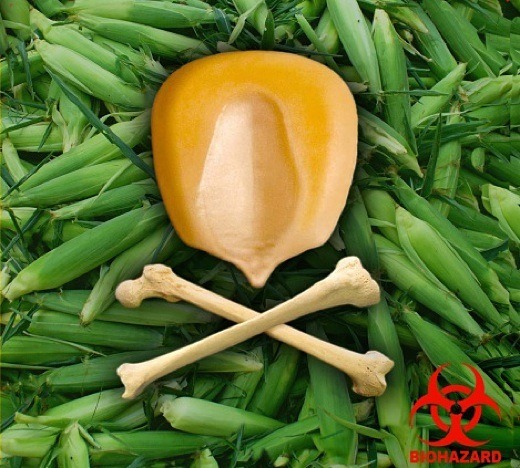
In 2007, Mexico's Chambers and Congress passed the "Law of Seeds" that prohibits farmers from trading or selling seeds they had cultivated [EPA]
| |||
| Felipe Calderon, the president of Mexico until the start of this month, has already relocated to his Cambridge, Massachusetts, home to fulfill his year-long fellowship at Harvard's Kennedy School of Government. On the way out of his country, he left the door open for multinational biotech companies, including Monsanto, DuPont and Dow Chemicals, that are on the prowl for new land to plant their genetically engineered crops after being all but booted from the European markets. When GE corn was introduced in the mid-90s, Mexico was inhospitable to the new-fangled crop. The country's National Biosecurity Commission established a (non-legally binding) moratorium on genetically engineered corn in 1998 as a means to safeguard what is considered to be the planet's cradle of maize cultivation. Corn has been carefully tended in Mexico for eight millennia and environmental conservationists report that thousands of peasant varieties are still grown throughout the country. With an estimated 75 per cent of the planet's biodiversity vanished as of 1995, Mexico's heterogeneous corn fields are a rare vestige of the age prior to the "Green Revolution" era that is responsible for the artificially and unhealthily homogenous industrial agriculture that is prevalent now. Introducing GE corn to Mexico would sound the death knell for this precious ecology as it is widely agreed that GE crops cannot co-exist with conventionally bred seeds. Traces of GE in corn Despite institutional protections against GE corn, neoliberal policies have already enabled certain strains of GE corn to intermingle with Mexican maize, a fact that was discovered in 2001 by UC Berkeley Professor, Ignacio Chapela.
But perhaps of more immediate threat to the magnificent biodiversity of Mexico's maize is the country's politicians' willingness to succumb to the pressure of big biotech companies. Over his past six years in office, Calderon has overseen the whittling away of the above-mentioned safeguards. In 2007, Mexico's Chambers and Congress passed the "Law of Seeds" that prohibits farmers from trading or selling seeds they had cultivated. And two months after Calderon met with the president of Monsanto, Hugh Grant, at the annual World Economic Forum in Davos, Switzerland, in January 2009, he lifted the 1998 moratorium on GE corn. This triggered a flood of applications for permits - the first of which came from Monsanto - to begin planting genetically modified maize. And, earlier this year, Mexican legislators came close to passing a bill that would modify the Federal Law on Plant Varieties which would promote privatising patents of certain breeds of plants. Comparable to how the enclosure acts in England created a landless working class, this legislation in Mexico would create a class of seedless farmers, planting the "property" (seeds) of transnational corporations that have monopolised the market for maize seeds. Thus, what is now controlled by the country's farmers would become the private property of corporations. However, Mexican farmers, small and large, responded to the proposed bill with forceful opposition, knowing full well the devastation that mono-cropping with bioengineered seeds would have on them - the examples provided by South and East Asia doubtless providing a stark warning. Veronica Villa, from the Colonia Insurgentes Mixcoac in Mexico City, explained to me that both commercial farmers of maize in the North and small indigenous farmers in the South (whose agricultural fields remain largely collective property and are used primarily to feed themselves) both fear the onslaught of GE corn. Those in the North fear the high costs and debts associated with transgenic corn, while the farmers in the South are the primary protectors of thousands of ancient varieties. Ecological destruction On the eve of elections, in a small but important victory, the highly unpopular bill was not presented to Congress, and the grassroots agricultural movement succeeded in keeping their own demise at bay for that moment. However, the bill is still pending and will likely be floated before Congress at a more politically opportune time.
Also still pending approval are requests by Monsanto and DuPont to plant 2,500,000 hectares of GM corn, which would signal a watershed in the agricultural landscape of Mexico. While Calderon left office before granting his blessing on the arrangement, all signs indicate that new President of Mexico, Enrique Pena Nieto, will be happy to put his imprimatur on the sweetheart deal for Big Biotech. Mexico's deputy agriculture secretary, Mariano Ruiz, told the press that the new president supported the introduction of large-scale GMO corn cultivation, saying, "I think we are in agreement generally over the importance of having this instrument, and that farmers have the tool of genetically modified organisms". Of course, farmers have all the tools they need without the meddling of chemical companies. While biotech companies have tried to float their products as being necessary in an era of climate-change, empirical studies have shown that the best defence for corn-farmers is diversity. Doug Gurian-Sherman, Senior Scientist with the Union for Concerned Scientists, warns of the far-reaching impact that supplanting Mexico's diverse maize plants with an industrial model could have. "Their diverse seeds contains many important traits like drought tolerance and pest resistance that we need going forward. If we lose them, we're going reduce our ability to respond to climate change and other threats to maize." Meanwhile, as Monsanto burrows into Mexico's cornfields, the biotech giant digs its rapacious claws further into the US - its single largest source of profits. The US Congress is expected to pass the FY 2013 Agriculture Appropriations Bill with the disturbingly anti-democratic "Monsanto-rider" embedded in the 90-page agreement, which would require the Secretary of Agriculture to override any federal court injunction on a GE crop and grant it a temporary permit. As long as politicians do not stand up for the health of their citizens or their land, biotech companies will reap profits in the grim wake of human and ecological destruction. Charlotte Silver is a journalist based in San Francisco and the West Bank. She is a graduate of Stanford University. Follow her on Twitter: @CharEsilver
The views expressed in this article are the author's own and do not necessarily reflect Al Jazeera's editorial policy.
|
Raising Sheep and Natural Rhythms

With raising sheep we respect natural rhythms beginning with the following basics:
- Starting with a flock of sheep suited to the environment and production year
- Building a flock of animals that are prime candidates for a natural grass based system with the goal to develop those genetics
- By selecting ewes and replacement ewe lambs who thrive on grass we will also be selecting for enhanced sheep health and disease resistance
- Lambing on pasture when there is an abundance of fresh grass to feed the ewes. If there is fresh grass it means the climate is warmer and that works in favour of the newborns
- Keeping ewes which are capable of raising lambs with ease and unassisted and who have the smarts to know which lambs are theirs
- Grazing sheep on grass for as long as possible every year. After the grass has become inaccessible finding ways to feed on pasture so animals remain there.
- Learn and utilize the benefits of raising sheep flocks on grass environments to improve upon our main resource, the grass
- Selecting sheep that are capable of finding shelter during poor weather. This is a learned survival trait that is taught to lambs
- Selecting for strong flocking instinct. This is one way sheep are able to protect themselves from predators such as the coyote
As our good friends taught us, always on our mind is how to make sheep work for us versus us working for the sheep.
This paradigm shift from working excessively hard to keep a ranch going, to making a ranch work for us, has had a tremendous impact on how we operate.
Sheep Shearing Tips

When you're trying to get through shearing a few hundred wool sheep or more, being ready for the day will help everyone stay on task.
- Bring the flock in the day before shearing
Having the flock under cover will keep them dry. Wet wool does not shear or store well. Most shearers will decline shearing your sheep if the fleece it too wet.
- Prevent the flock from feeding and watering the night before
The shearer needs to handle the animal and hold it in a secure position when clipping the fleece. This is far more comfortable for the ewe if she doesn't have a belly full of feed. Since the rumen can hold quite a bit of food it also makes the shearers job easier if the animal is empty.
- Set up in advance
If your system is a portable one, set up the pens and race ahead of time. If it is a permanent set up make sure any repairs are done and the system is operational. The shearing crew are busy people and having to wait for set up only delays them for the next farm down the line.
- Sort your animals prior to shearing
Keep animals of different wool types separate. This will aid you when it comes to the wool grading process.
- Have extra help on hand
This sheep shearing tip can really make the difference on shearing day. Hire extra hands if needed.
It can be a long day trying to keep up to a crew of shearers without having the assistance you need. You also hold the shearers back when you don't have enough help to keep up to them. As a rule of thumb have one person per shearer plus two to three extra for other jobs like moving sheep and packing wool.
- Consider doing other flock treatments at the same time
You'll have the flock in anyway and if you can manage with an spare person to take on the extra duty, shearing day can also double as opportunity to do an annual flock treatment like vaccination.
- Have a head gate at the end of the race
Catch the first ewe to come down the race in the head gate and leave her there. She'll stand comfortably and will draw the remaining animals up the race. This is one of the simplest sheep shearing tips to put into practice yet it can make a world of difference to how the day progresses.
- Prepare meals ahead of time
One of the highlights of shearing day is that it involves a meal with friends. It's often customary to feed the shearing crew and the extra help who have graciously assisted.
We often plan meals that can be put on to cook while we work. We've also utilized the cooking talents of family members and have had them attend to the cooking for us.
If the day is long every ones spirits will be kept up with breaks for coffee and snack refreshments for energy. Our shearing crew enjoy healthy snacks that won't make them tired such as fruit and granola bars.
- Be flexibleSometime the shearers can't get to you on the scheduled day. Delays at previous stops can add up in a hurry. Don't be angry if the shearer phones to say he can't make it. Consider that he's also trying to keep a feasible schedule and route and is relying on a whole lot of other people being ready. A good shearer will be sure to come back and fit you in.
Promotion olive Cultivation for economic development in poverty alleviation
|
With high global demand and rising prices in the international market
and Pakistan’s annual edible oil import bill exceeding $2bn, the rationale of
recent olive cultivation initiatives in the country cannot be overemphasized.
Olive demand globally is on the rise. Germans are using five times more and
British ten times more olive than they did in 1990. In America, olive demand is
growing by 6pc annually for two decades now. Olive prices in world market have
doubled to $3,400 a ton recently. Pakistan has over 0.8mn hectares of wasteland
suitable for olive cultivation. An official of the now defunct Pakistan Oil
Seeds Development Board (PODB) had told this writer that by covering the area
with olive plants, Pakistan can produce around 1.84mn tons of olive oil. This
would fetch over $6bn at the current rate of olive in world market.
The Pakistan agricultural research council (PARC) has begun
implementing the project “Promotion of olive cultivation for economic
development and poverty alleviation” whereby olive plants will be cultivated on
300 hectares in Balochistan, 100 hectares in KP, 300 hectares in federally
administered tribal areas and 100 hectares in the Pothohar region of Punjab. The
Rs382mn project to be completed in three years is being under the Pakistan
Italian debt-for-development swap agreement.
|
 |
|
The Punjab Agriculture and Meat Company also plans to develop 10
certified nurseries. These nurseries –being opened through private sector in
Attock, Rawalpindi, Chakwal, Jehlum and Khushab districts –would have a
catchment area of 27000 acres and would have an impact of $78mn. The potential
area suitable for olive cultivation is around 8mn acres in Punjab of which 0.4mn
is being targeted though this initiative. Total impact of this land, if covered,
would be $1.16bn.
| |
The New breed: Pakistan olive plantation intiatives

Scientists discover bees can ‘turn back time,’ reverse brain aging
 Scientists at Arizona State University have discovered that older honey bees effectively reverse brain aging when they take on nest responsibilities typically handled by much younger bees. While current research on human age-related dementia focuses on potential new drug treatments, researchers say these findings suggest that social interventions may be used to slow or treat age-related dementia.